
Areas we cover
We work on original timber sash windows across London and the South East, mostly on whole houses rather than single windows.
We cover London and the South East — Greater London plus Surrey, Kent, Sussex, Essex, Hertfordshire, Berkshire, Buckinghamshire and Oxfordshire. The work is done from inside the room, so no scaffolding is required and upper floors and flats are no harder than ground floors.
Where we work
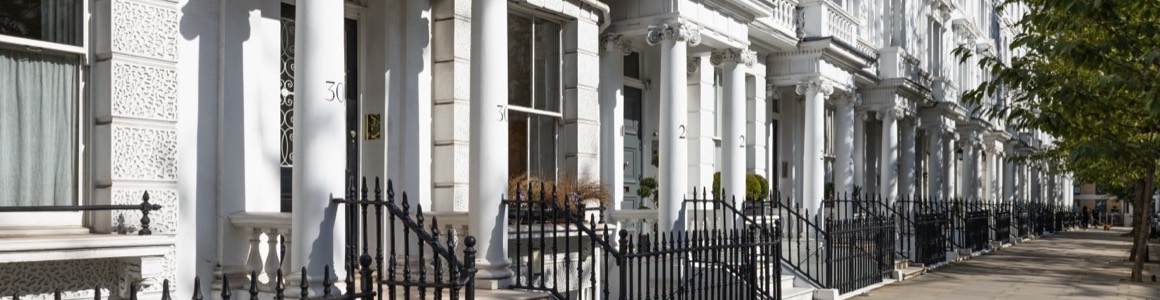
Our work is concentrated where the housing stock is: the Georgian, Victorian and Edwardian terraces and villas that still have their original box sashes. That means central and inner London most of all, and the older parts of the commuter towns around it.
London
Most of what we do is in London — north, south, east and west. Typical work is a whole terraced house, six to twelve sashes, done over two or three days, room by room. In conservation areas, which cover a great deal of inner London, draught proofing is usually the most acceptable way of improving an old window precisely because it keeps the window. Do check whether an Article 4 Direction applies to your street before assuming anything about replacement.
The South East
Outside London we cover Surrey, Kent, Sussex, Essex, Hertfordshire, Berkshire, Buckinghamshire and Oxfordshire. Travel is easier to justify on a whole-house job, so if you are at the edge of that area and have several windows, ask.
The properties we mostly work on
- Georgian and early Victorian townhouses — often six-over-six or larger, frequently listed, sometimes with Venetian or curved sashes that price differently.
- Victorian and Edwardian terraces — the bulk of the work. Usually two-over-two with horns, and usually a whole house at a time.
- Period conversions and flats — commonly a handful of sashes, so worth grouping with neighbours if you can.
- 1920s and 1930s houses — later box sashes and some solid-frame sashes, which have no weight box and are sealed slightly differently.
What makes a job practical
Three things move the price more than distance does.
- Number of windows. The dominant factor. Most of the cost is skilled time and set-up, so the second window in a visit is cheaper than the first. See the cost page.
- Condition. Rot at the cill or the base of the stiles has to be repaired before sealing — Historic England is explicit that repairs come first, and notes repairs alone can cut air infiltration and heat loss by up to a third.
- Access and parking. Sashes are heavy and awkward. A controlled parking zone with no loading bay adds real time to a job.
If you would like a guide price, send the number of sashes and your postcode via the contact page.